
01 Oct 2026
Retorting Explained: A Complete Guide to Retort Pouches, Ready-to-Eat Food Processing and Sealing
Learn how retorting works, how ready-to-eat foods are processed, why proper pouch sealing matters, and how to choose a retort pouch sealer for reliable food packaging.
1. What Is Retorting?
Retorting is a thermal food-processing method used to make certain packaged foods shelf-stable. The food is filled into a suitable package, sealed, and then heated under controlled temperature, time, and pressure conditions.
The basic principle is similar to traditional canning. However, retort processing can also be carried out using flexible packages such as retort pouches, allowing ready-to-eat foods to be packed in lightweight and convenient formats.
During retorting, the sealed package is placed inside a retort or autoclave. Heat is applied for a defined period to achieve the required level of commercial sterilization. The exact processing schedule depends on the food product, package, formulation, package size, and the required processing objective.
Heating or Come-Up Stage
The retort is gradually brought up to the required processing temperature. Heat begins transferring through the package into the food.
Holding or Processing Stage
Once the required processing conditions are reached, the food is held under controlled temperature and pressure for a defined period. This stage is important for achieving the required thermal treatment.
Cooling Stage
After processing, the packages are cooled under controlled conditions. Cooling limits further heat exposure and helps maintain product quality. For flexible packages, controlled pressure during cooling can also help reduce the risk of pouch deformation or failure.
The actual retort temperature and processing time should always be established and validated for the specific food product and packaging system.
2. What Is a Retort Pouch?
A retort pouch is a flexible food package designed to withstand the temperature, pressure, and processing conditions used during retort processing.
Unlike an ordinary food pouch, a retort pouch uses packaging materials selected specifically for high-temperature food processing. The package normally consists of multiple layers, with each layer performing a particular function.
PET (Polyester) Outer Layer
PET, or Polyester, is commonly used as an outer layer because it provides strength, toughness, heat resistance, and a suitable surface for printing.
Barrier Layer
A barrier layer helps protect the food from oxygen, moisture, light, or other external influences. Aluminum foil is commonly used when a high barrier is required, while transparent retort structures can use alternative barrier materials.
Heat-Sealing Layer
The inner layer is designed to provide a reliable heat seal and to be suitable for food contact. The complete packaging structure must be selected according to the food product and retort process.
The pouch is filled and sealed before it enters the retort. The quality of this seal is therefore an important part of the overall retort packaging process.
3. How Does the Retorting Process Work?
Retort processing is part of a complete ready-to-eat food production process. The basic sequence is:
- Food preparation
- Filling
- Pouch sealing
- Retort processing
- Cooling
- Inspection and storage
1. Food Preparation
The food is prepared according to the product recipe. This may include cooking, mixing, seasoning, or other preparation steps before filling.
2. Filling
The prepared food is filled into a retort-compatible pouch. The filling quantity and headspace need to be controlled according to the product and packaging process.
3. Pouch Sealing
The filled pouch is sealed using a suitable retort pouch sealer. The seal must be consistent and strong enough to remain intact during the subsequent retort process.
4. Retort Processing
The sealed pouches are placed inside the retort. Controlled heat, pressure, and time are applied according to the validated processing schedule for the product.
5. Cooling
After the required thermal treatment, the pouches are cooled under controlled conditions.
6. Inspection and Storage
The processed pouches can then be inspected for package integrity, seal quality, leakage, deformation, and other visible defects before storage and distribution.
4. Why Is Proper Retort Pouch Sealing Important?
Retort processing exposes the sealed package to elevated temperature and pressure. The package also experiences changes during cooling. The seal therefore needs to maintain its integrity throughout the complete process.
A poor or inconsistent seal can result in leakage, pouch opening, loss of package integrity, or contamination after processing.
Important Sealing Factors
- Sealing pressure
- Sealing temperature
- Sealing time
- Sealing jaw condition
- Jaw alignment
- Seal width
- Cooling of the sealing area
- Cleanliness of the seal area
The filled product should also be kept away from the sealing area as far as practical. Food particles, oil, gravy, or other product residues in the seal area can affect seal quality.
Consistent sealing is therefore an important part of producing reliable retort-processed ready-to-eat food products.
5. What Makes a Pouch Suitable for Retorting?
A retort pouch must be designed for the conditions it will experience during processing. The packaging structure should be selected together with the food product and the retort process.
Temperature Resistance
The pouch materials must withstand the required retort temperature without unacceptable loss of mechanical or sealing performance.
Pressure Resistance
The package must remain intact while experiencing pressure changes inside the retort, including during cooling.
Barrier Properties
The packaging structure should provide the required protection against oxygen, moisture, light, and other environmental factors according to the product requirements.
Seal Integrity
The heat-sealed area must remain intact throughout filling, handling, retorting, cooling, transportation, and storage.
Mechanical Strength
The pouch needs sufficient strength to withstand handling and the stresses associated with the retort process.
The appropriate pouch structure depends on the food product, processing conditions, package size, required barrier properties, and intended storage conditions.
6. Retort Pouch Sealing Before Retort Processing
Retort pouch sealing and retort processing are two different stages of food production.
The sealer closes the filled pouch. The retort then applies the controlled thermal processing required for the food product.
The basic sequence is:
Food Preparation → Filling → Pouch Sealing → Retort Processing → Cooling
The Role of the Sealer
A retort pouch sealer is responsible for producing a consistent seal on the filled pouch before the package enters the retort.
The Role of the Retort
The retort is the processing equipment that applies the required temperature, pressure, and time to the sealed food package.
A retort pouch sealer does not replace the retort and does not sterilize the food. Both stages are part of the complete processing system.
7. Applications of Retort Pouches
Retort pouches are used for a wide range of packaged foods where convenient, shelf-stable formats are required.
Ready-to-Eat Meals
Retort processing can be used for packaged ready-to-eat meals that can be heated and consumed with minimal preparation.
Curries and Gravies
Products such as paneer butter masala, chana masala, chicken curry, mutton preparations, and other gravy-based foods can be packed in suitable retort pouches.
Dals and Lentil-Based Foods
Dal makhani, dal tadka, sambar, and other prepared lentil-based foods are examples of products that may be suitable for retort processing when the packaging and process are properly developed.
Rice and Grain-Based Foods
Products such as vegetable pulao, biryani, jeera rice, and other prepared rice or grain-based meals can be packaged in retort-compatible formats.
Meat and Seafood Products
Selected meat, poultry, and seafood preparations can also be processed using retort packaging, subject to appropriate product formulation and validated processing conditions.
8. Foods Commonly Packed in Retort Pouches
Retort packaging is particularly useful for prepared foods that benefit from convenient storage, transportation, and preparation.
- Ready-to-eat meals
- Curries and gravies
- Dal and lentil preparations
- Sambar and similar prepared foods
- Rice-based meals
- Biryani and pulao
- Cooking sauces and food bases
- Selected meat and poultry preparations
- Selected seafood preparations
- Selected prepared vegetables
- Selected desserts and traditional prepared foods
Examples include paneer-based curries, chana masala, dal makhani, chicken curry, mutton curry, biryani, pulao, and other ready-to-eat food products.
Not every food product is processed using the same retort conditions. The formulation, package, filling quantity, and thermal processing schedule need to be considered for each product.
9. What Is a Retort Pouch Sealer?
A retort pouch sealer is a sealing machine used to close filled retort-compatible pouches before they undergo retort processing.
Its primary function is to produce a consistent and reliable seal along the pouch opening. The machine does not perform the retort process itself.
Pneumatic Sealing
Pneumatic sealing uses compressed air to apply controlled force to the sealing jaws. This provides a consistent mechanical sealing action when the machine is correctly adjusted and operated.
Sealing Time and Temperature
The sealing conditions need to be suitable for the pouch material and sealing structure. Sealing time, temperature, pressure, and other machine parameters can affect the resulting seal.
Water-Cooled Sealing Jaws
Cooling of the sealing jaws can help control the sealing area and maintain consistent sealing characteristics during production, particularly when working with suitable retort packaging structures.
The exact sealing parameters should be established according to the pouch manufacturer's material specification and the requirements of the particular food product.
10. How to Choose a Retort Pouch Sealer
When selecting a retort pouch sealer for ready-to-eat food production, the machine should be considered as part of the complete filling and retort packaging process.
Check the Pouch Material
Confirm that the sealer is suitable for the retort pouch structure being used, including structures incorporating PET (Polyester), aluminum foil, and appropriate heat-sealing layers.
Check the Required Seal Width
The required seal width depends on the pouch construction and application. The sealing equipment should provide the required seal consistently across the production run.
Check Sealing Length
The sealing length should accommodate the pouch opening and production requirements.
Check Pneumatic Requirements
For pneumatic sealers, ensure that the facility can provide the required compressed-air pressure consistently.
Consider Cooling
Where the packaging process requires controlled jaw cooling, the machine should provide an appropriate cooling arrangement.
Consider Production Requirements
Sealing time, pouch dimensions, production volume, operator workflow, and integration with the filling process should all be considered when selecting the equipment.
11. Retort Pouch Sealing Solution from Sevana
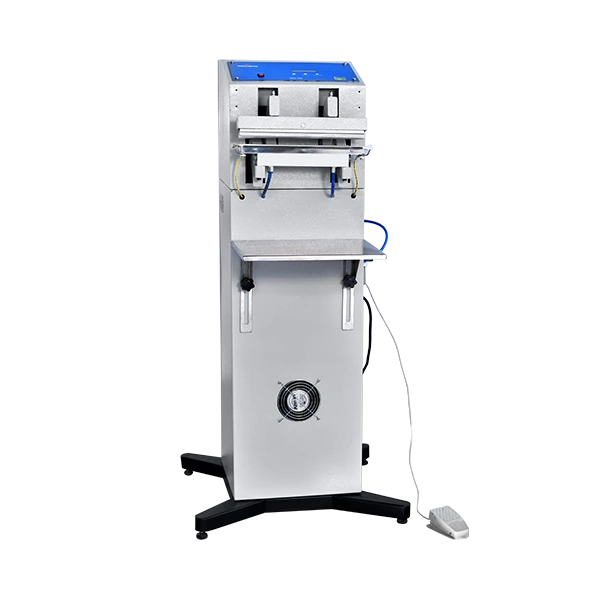
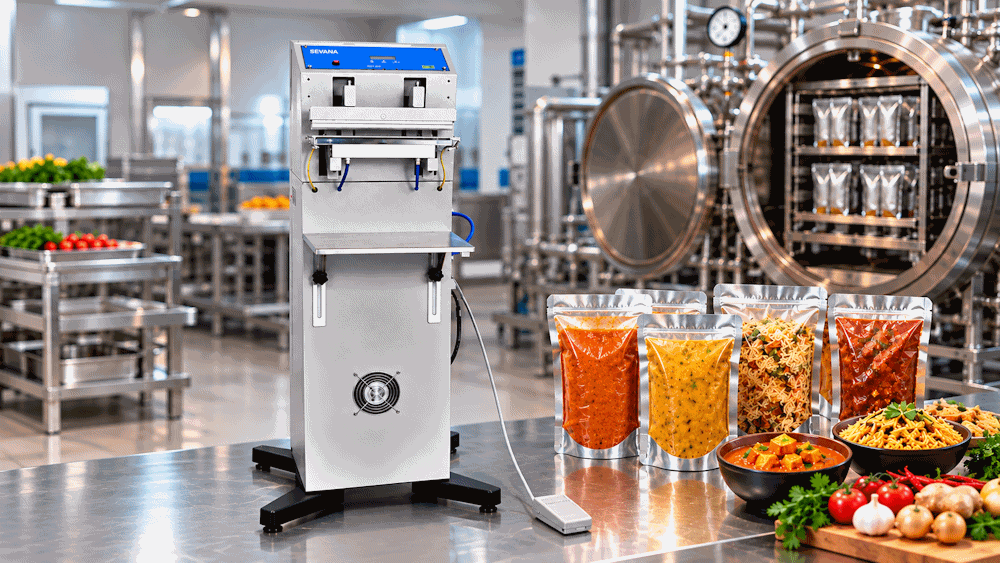
Sevana offers the QS300×10PNI Pneumatic Sealer for sealing retort-compatible pouches used in ready-to-eat food packaging applications.
The machine uses pneumatic sealing and is designed to provide consistent sealing of filled pouches before they proceed to retort processing.
QS300×10PNI Specifications
| Specification | Details |
|---|---|
| Sealing Length | 300 mm |
| Sealing Width | 10 mm |
| Sealing Method | Pneumatic |
| Compressed Air Pressure | 6–8 kg/cm² |
| Sealing Time | 0–9 seconds |
| Voltage / Frequency | 240 V / 50 Hz |
| Power | 1600 W |
| Machine Dimensions | 660 × 710 × 1250 (+40*) mm |
| Weight | 61 kg |
Cooling Provision
The QS300×10PNI has provision for cooling the sealing jaws. Running water can be provided for the cooling arrangement, or a suitable Sevana cooling system can be used.
Where the QS300×10PNI Fits in the Process
The machine is used at the pouch-sealing stage:
Food Preparation → Filling → QS300×10PNI Pouch Sealing → Retort Processing → Cooling → Finished Product
The QS300×10PNI performs the pouch sealing operation. It does not perform retort processing or sterilization.
It can be considered for manufacturers producing ready-to-eat foods, curries, gravies, dals, rice-based foods, and other suitable food products packed in retort-compatible pouches.
12. Frequently Asked Questions About Retorting
What is retorting?
Retorting is a controlled thermal food-processing method in which sealed food packages are heated under defined temperature, pressure, and time conditions to achieve commercial sterilization and produce shelf-stable products when the process has been properly developed and validated.
What is a retort pouch?
A retort pouch is a flexible package designed to withstand the temperature, pressure, and processing conditions used during retort processing.
Can ready-to-eat food be packed in retort pouches?
Yes. Many ready-to-eat foods, including curries, gravies, dals, rice-based meals, and selected meat and seafood products, can be processed in suitable retort pouches when the packaging and thermal process are properly developed and validated.
Does a retort pouch sealer perform the retort process?
No. A retort pouch sealer seals the filled pouch. Retort processing is performed separately in a retort or autoclave.
Why is pouch sealing important before retorting?
The seal must remain intact during heating, pressure changes, cooling, handling, and storage. A weak or inconsistent seal can compromise package integrity.
What is a pneumatic pouch sealer?
A pneumatic pouch sealer uses compressed air to apply controlled force to the sealing jaws. This provides a consistent sealing action when the machine is correctly set and operated.
Why is cooling provided for the sealing jaws?
Controlled jaw cooling can help manage the sealing area and maintain consistent sealing characteristics during production. The appropriate cooling arrangement depends on the pouch material and sealing process.
What temperature is used during retort processing?
Retort processing commonly uses temperatures in the range of approximately 115–121°C, but the actual temperature and processing time depend on the food product, package, process objective, and validated processing schedule.
How long does retort processing take?
There is no single processing time for every product. The required time depends on factors such as food composition, package size, filling conditions, processing temperature, and the required thermal treatment.
Does retort processing give every product the same shelf life?
No. Shelf life depends on the food formulation, packaging materials, processing conditions, package integrity, storage conditions, and other factors. Shelf life should be established through appropriate product and packaging validation rather than assumed from the retort process alone.
Conclusion
Retorting is an important food-processing method for producing convenient, shelf-stable ready-to-eat foods. The overall process involves food preparation, filling, pouch sealing, retort processing, cooling, and final inspection.
While the retort performs the thermal processing, the pouch sealer plays an important role before the package enters the retort. A consistent and reliable seal helps maintain package integrity throughout the subsequent heating and cooling stages.
For manufacturers of ready-to-eat foods, curries, gravies, dals, rice-based meals, and other suitable products, selecting the right retort-compatible pouch and sealing equipment is an important part of developing a reliable packaging process.
Sevana QS300×10PNI provides pneumatic sealing for retort-compatible food pouches, with a 300 mm sealing length, 10 mm sealing width, and provision for sealing-jaw cooling.